
The engagement was more than an SFCC-to-Shopify migration. The platform change was real, but it exposed a larger commerce operating-model decision. Custom development, partner handoffs, release queues, and data rules around OMS, PIM, ERP, POS, CRM, and analytics had created a reality where routine updates were too expensive for the business to sustain. Shopify created an opportunity for faster, more controlled change, but only if the migration addressed the operating model around the platform.
This case study has been anonymized. Client and partner names, proprietary architecture specifics, and commercial figures have been generalized. The operating pattern and decision framework are consistent with the kind of work JM Digital Corp does with retail and digital commerce leadership teams.
Executive Summary
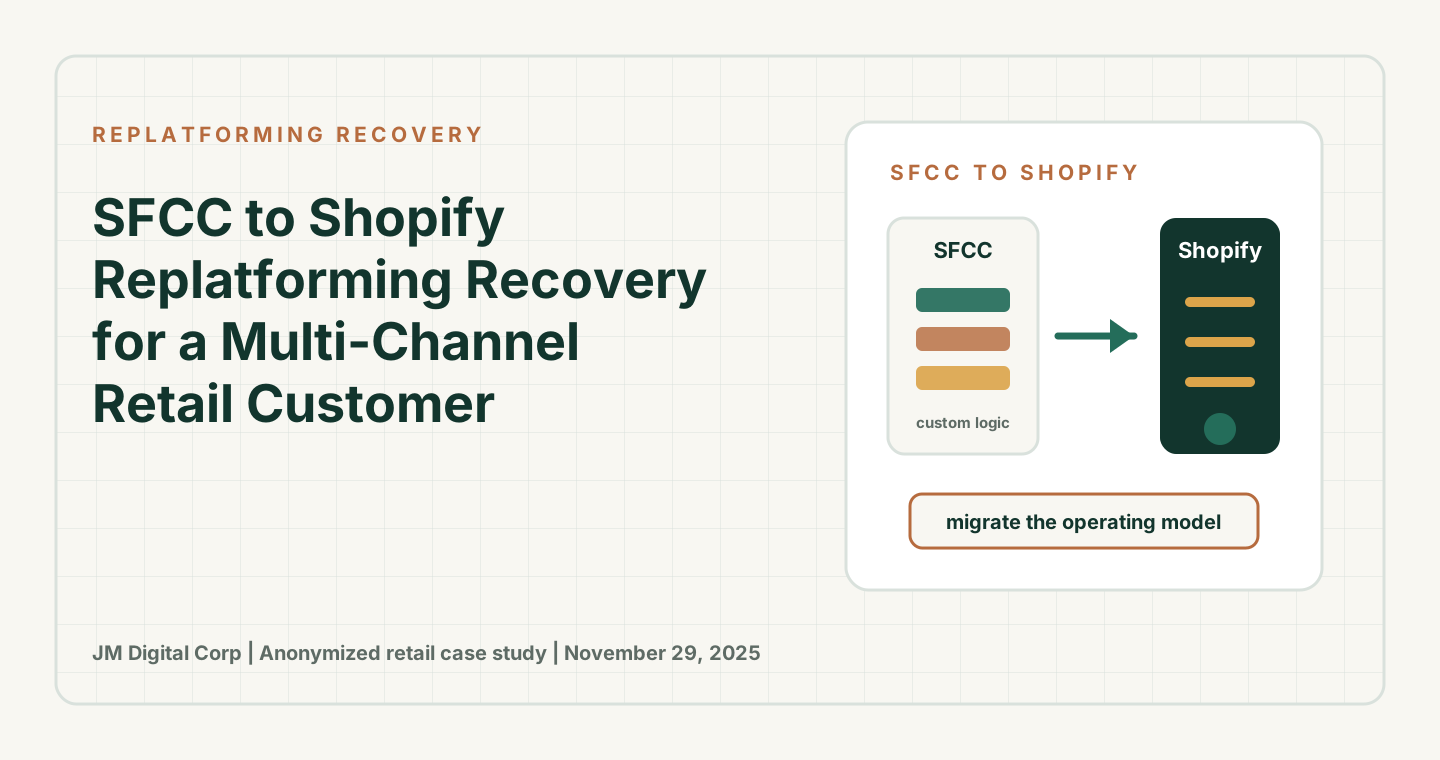
SFCC to Shopify ReplatformingThe decision went beyond swapping one commerce platform for another. SFCC had been doing its job for the company, and some of its custom behavior still mattered. Shopify became the better fit at this stage because it supported faster merchandising, less release coordination, less custom code, and better local control over the flows closest to the customer experience. JM Digital Corp kept the assessment platform agnostic and isolated true SFCC constraints from other operating-model challenges, including checkout rules, product and inventory data, OMS handoffs, PIM ownership, POS and store impacts, CRM identity, analytics, SEO, app governance, partner scope, and decision-making rights.
Client Context
It usually takes more than platform capability for a retailer to consider moving away from Salesforce Commerce Cloud. For this client, the key driver was the need to speed up routine changes to the merchandising experience. At the same time, the technology team needed to reduce bottlenecks in the release process. Operations needed checkout, inventory management, order handling, returns, and service capabilities to remain reliable as volume increased.
Shopify became interesting as a way to make customer experience investment easier without turning every change into another major implementation effort. The platform could simplify the commerce surface, but the migration still required discipline. Certain SFCC customizations protected important checkout and fulfillment behavior. Others reflected inherited decisions, unclear business ownership, or functionality whose value was no longer obvious.
Several challenges looked like SFCC platform issues at first glance, but were actually product data problems, OMS or ERP rules, analytics gaps, partner dependency, or decision-rights issues. The review did not treat SFCC as the problem or Shopify as the automatic alternative. In this case, the advisory work focused on what to retain, what to retire, which flows to redesign, which rules belonged upstream, and which legacy practices to stop carrying forward.
Where the Risk Actually Lived
Each function explained the pressure differently. Merchandising viewed the migration as a way to accelerate change. Technology viewed it as a way to reduce release complexity and custom development load. Operations saw an opportunity to protect checkout, inventory, fulfillment, returns, and order-handling reliability. Finance needed accurate reporting that could stand up to executive scrutiny. Marketing wanted faster campaigns without adding risk around consent, identity, attribution, or campaign measurement.
Shopify could provide the commerce functionality this client was looking for. The potential risk was building the same operating model in a new platform: excess apps, custom integrations, weak data management, weak SEO governance, unclear exception ownership, and a migration plan that transferred complexity to downstream teams.
Before implementation scope became final, leadership needed direct answers. Which SFCC constraints were really coming from SFCC itself? Which ones were driven by the architecture around SFCC? Which decisions belonged with data owners, partners, or business stakeholders? Otherwise, implementation scope would absorb the unanswered operating questions.
Signals of deeper operating risk
- Routine merchandising and content changes required excessive planning, QA, partner coordination, and release sequencing.
- The same friction appeared under different names: SFCC limitation, OMS or PIM constraint, partner dependency, or decision-rights issue.
- Valuable SFCC behavior was mixed with legacy customizations, so the team could not distinguish what still deserved to move forward.
- Inventory, orders, returns, SEO, campaigns, analytics, and support were planned separately, even though customers would experience them as one journey.
- A credible business case had to demonstrate lower change cost and higher customer confidence, rather than a shift from one platform budget to another.
- Before partner scope was locked, leadership needed a clear separation between cleanup, implementation scope, launch controls, and post-launch stabilization.
Approach
Baseline the SFCC Environment
Understand which constraints came from Salesforce Commerce Cloud and which ones came from custom development, cartridges, partner scope, data ownership, release practices, or business processes.
Compare Platform Tradeoffs
Compare SFCC and Shopify based on this retailer's realities: cost, extensibility, ownership, partner dependency, release process, and change speed.
Define the Shopify Target Model
Clarify which capabilities belong to Shopify natively, which belong in apps, which require custom work, and which belong upstream in ERP, OMS, PIM, WMS, POS, CRM, and data platforms.
Test Real Operating Scenarios
Test product publishing, promotions, checkout, tax, payments, inventory availability, order routing, returns, accounts, analytics, SEO redirects, and campaign activation in the target model.
Require Partner Evidence
Ask Shopify partners, app providers, integration teams, and internal owners to validate assumptions related to scope, cost, feasibility, ownership, and launch risk.
Name the Decision Owners
Assign clear owners to difficult calls across ecommerce, merchandising, stores, fulfillment, finance, marketing, technology, security, partners, and vendors.
Treat Launch as an Operating Event
Establish gates for data migration, SEO, order flow, analytics, rollback, support coverage, and the first 30 days after launch.
Platform-Agnostic Comparison
Salesforce Commerce Cloud is a strong commerce platform for retailers that need deep customization, complex promotion models, global catalog structures, mature engineering practices, and a team willing to own a more customized release model.
The tradeoff is complexity. Cartridges, custom exceptions, partner-specific code, and release dependencies can grow to the point where they become part of how the business operates. Shopify is powerful when a retailer is ready to standardize more of the commerce foundation and reduce the need for storefront customization. It can accelerate merchandising cycles, reduce storefront complexity, and extend capability through native features and apps.
Shopify still requires governance. Apps without owners, loose data contracts, and custom code created out of habit can lead to the same complexity in a different platform environment. For this client, Shopify was the better fit because the business did not need maximum custom control. It needed faster customer-facing work, clearer ownership, fewer custom touchpoints, and a better operating rhythm around product data, conversion, inventory promise, and reliability. This was a client-specific conclusion, not a general evaluation of platforms.
How the Migration Was Reframed
The review focused on the operating path behind the target-state diagram. Product data was traced from creation to enrichment, approval, publishing, pricing, merchandising, indexing, sale, fulfillment, return, reporting, and support. That clarified which customer commitments Shopify had to protect and which SFCC-era behaviors had become habits.
The review then moved through five working layers: platform fit, integration fit, data readiness, governance, and delivery readiness. Platform fit covered themes, checkout, search, localization, promotions, and scale. Integration fit covered ERP, OMS, PIM, WMS, POS, CRM, martech, tax, payments, fraud, analytics, and middleware. Data readiness covered product, price, inventory, customer, orders, returns, redirects, content, and reporting data. Governance covered access, approvals, QA, release management, app selection, and vendor oversight. Delivery readiness covered cutover, support, hypercare, and decisions that needed to be made before development.
At that point, the migration no longer looked like a simple platform swap. Some SFCC customizations could be abandoned. Others could be replaced by Shopify-native functionality. Some needed a thoughtful app decision. Some needed to sit outside Shopify.
SFCC-to-Shopify Migration Gotchas
One-to-one reconstruction was the first risk. A mature SFCC environment usually contains custom behaviors, cartridges, exceptions, integrations, and workarounds developed over many years. Recreating the same thing in Shopify would preserve the cost structure while changing the administrative interface. The better question was which customer commitments to preserve and how Shopify could support them with less long-term complexity.
The second risk was app sprawl. Apps in the Shopify ecosystem can be a major advantage, but every app introduces a vendor, data contract, performance consideration, support process, and eventual renewal discussion. Apps add value when they reduce complexity. They become risky when they hide it.
The third risk was migration specificity. Product handles, variants, collections, images, metafields, redirects, structured data, URL strategy, analytics events, customer records, historical orders, content pages, and search indexing all needed owners before cutover. A successful launch is more than a storefront that looks good. It is a storefront where customers, search engines, service teams, finance, marketing, and operations can trust what they see.
Delivery Leadership Model
The migration was organized around decisions rather than tasks alone. Ecommerce owned storefront, checkout, promotions, search, content, and app choices. Platform owned integrations, data contracts, APIs, environments, security, access, and release management. Operations owned order routing, inventory promise, fulfillment, returns, store impact, service visibility, and support. Business leadership owned tradeoffs that implementation teams could not make on its behalf.
Cutover also required this level of governance. Product and content freeze decisions, migration rehearsals, redirect validation, analytics parity, payment and tax validation, order-flow validation, inventory reconciliation, customer service readiness, incident management, rollback decisions, and hypercare were treated as launch controls.
This approach put tension in the right place early. When speed was the priority, the team had to avoid unnecessary custom parity with SFCC. When reliability was important, data contracts and integration testing could not be postponed until the end. When ROI mattered, the move had to lower long-term change cost rather than shift the same budget to another vendor stack.
Business Impact Logic
Leadership also needed a business case it could defend. Would promotions launch faster? Would bottlenecks decrease? Would fewer content-update defects reach customers? Would teams trust product, inventory, order, and analytics data? Would the move reduce late escalations, or just transfer them to another owner?
Cost had to be understood in the same direct way. SFCC complexity was showing up through customization, partner dependency, manual reconciliation, slow QA, and weak ownership. Shopify had the potential to reduce some of those burdens, but only if the migration did not repeat unnecessary parity work, weak app governance, unmanaged app choices, or poor integration contracts.
Once the platform discussion was tied to business outcomes, the conversation became more effective: faster change, reduced cost, improved operational control, stronger customer commitments, and fewer surprises after launch.
What Changed for Leadership
As a result of the review, the client had the key decisions in one place: current constraints, scenarios tested, root cause analysis, Shopify target model principles, integration risks, app governance, data migration decisions, ownership gaps, launch controls, and the first 90 days of stabilization work.
That changed the interaction with Shopify partners, app vendors, integration teams, and internal owners. It also made it harder to treat the project as a front-end rebuild. The operating model affected product, inventory, orders, fulfillment, customer data, finance, marketing, analytics, stores, service, and technology.
The leadership question became concrete: if Shopify becomes the new commerce foundation, what has to change around it so the business does not recreate the same friction in a cleaner interface?
What changed after the review
Migration Decision Map
A picture of what moves to Shopify, what changes, what is retired, and what remains in surrounding systems.
SFCC and Shopify Tradeoffs
A comparison of where SFCC still makes sense, where Shopify fits better, and which tradeoffs leadership accepts.
Integration Proof Points
Specific criteria for ERP, OMS, PIM, WMS, POS, CRM, analytics, tax, payments, redirects, customer records, and order-flow integration.
App and Custom-Code Rules
Decision rules for native Shopify, apps, custom development, integration services, and upstream ownership.
Launch and Hypercare Controls
Launch criteria for SEO, redirects, analytics, checkout, inventory, order flow, support, rollback, and hypercare.
When this case study is relevant
- A Salesforce Commerce Cloud to Shopify move is being evaluated, and the team does not want to rebuild old complexity.
- SFCC customizations, cartridges, release cycles, or partner dependency are making routine commerce work too expensive.
- Shopify appears to be the right direction, but the team has not decided what belongs natively in Shopify, what belongs in apps, what requires custom work, what needs integration, and what stays upstream.
- ERP, OMS, PIM, POS, WMS, CRM, analytics, stores, fulfillment, or service teams all influence the customer promise.
- Leadership needs a stronger business case, partner scope, launch plan, and stabilization model before committing budget.
- The team cannot agree whether the constraint is platform fit, implementation quality, architecture, data readiness, or ownership.
Related reading
Read the strategy behind this case study
These JM Digital Corp insights expand the architecture, data ownership, operating model, and platform thinking behind this diagnostic approach.
Planning an SFCC-to-Shopify move?
Before scope locks, JM Digital can help pressure-test platform fit, operating ownership, integration risk, cutover readiness, and the business case.
Request a replatforming review