
A platform selection decision cannot start with a feature matrix. It has to start with the operating truth behind product data, customer identity, inventory, orders, finance, campaigns, analytics, and the teams that depend on them.
Executive Summary
Platform Integration | Published July 24, 2026Choosing a retail platform that integrates with POS, CRM, ERP, OMS, PIM, and martech is less about counting connectors and more about proving how the business will operate across them. The right platform clarifies which systems own which record, how events move, where latency is acceptable, what governance is required, and how the investment improves customer experience, margin, speed, and decision quality.
Key takeaways
- A connector list is not an integration strategy. Leaders need to know which system owns product, customer, order, inventory, pricing, promotion, and financial truth.
- The strongest platform evaluations test real operating scenarios across POS, CRM, ERP, OMS, PIM, martech, analytics, stores, and service teams.
- API-first and composable approaches can create flexibility, but only when governance, data ownership, observability, and support capacity exist.
- The business case needs to connect integration decisions to measurable outcomes such as faster launches, fewer exceptions, cleaner reporting, lower vendor dependency, and better customer confidence.
Why platform integration is a leadership decision
Retail platform selection is often treated as a technical procurement exercise. The team compares demos, scores features, checks references, reviews implementation timelines, and asks whether the platform integrates with the systems already in place. That work is necessary, but it is not enough. A platform can have connectors for POS, CRM, ERP, OMS, PIM, and martech and still fail to create operating leverage if the business has not decided how those systems work together.
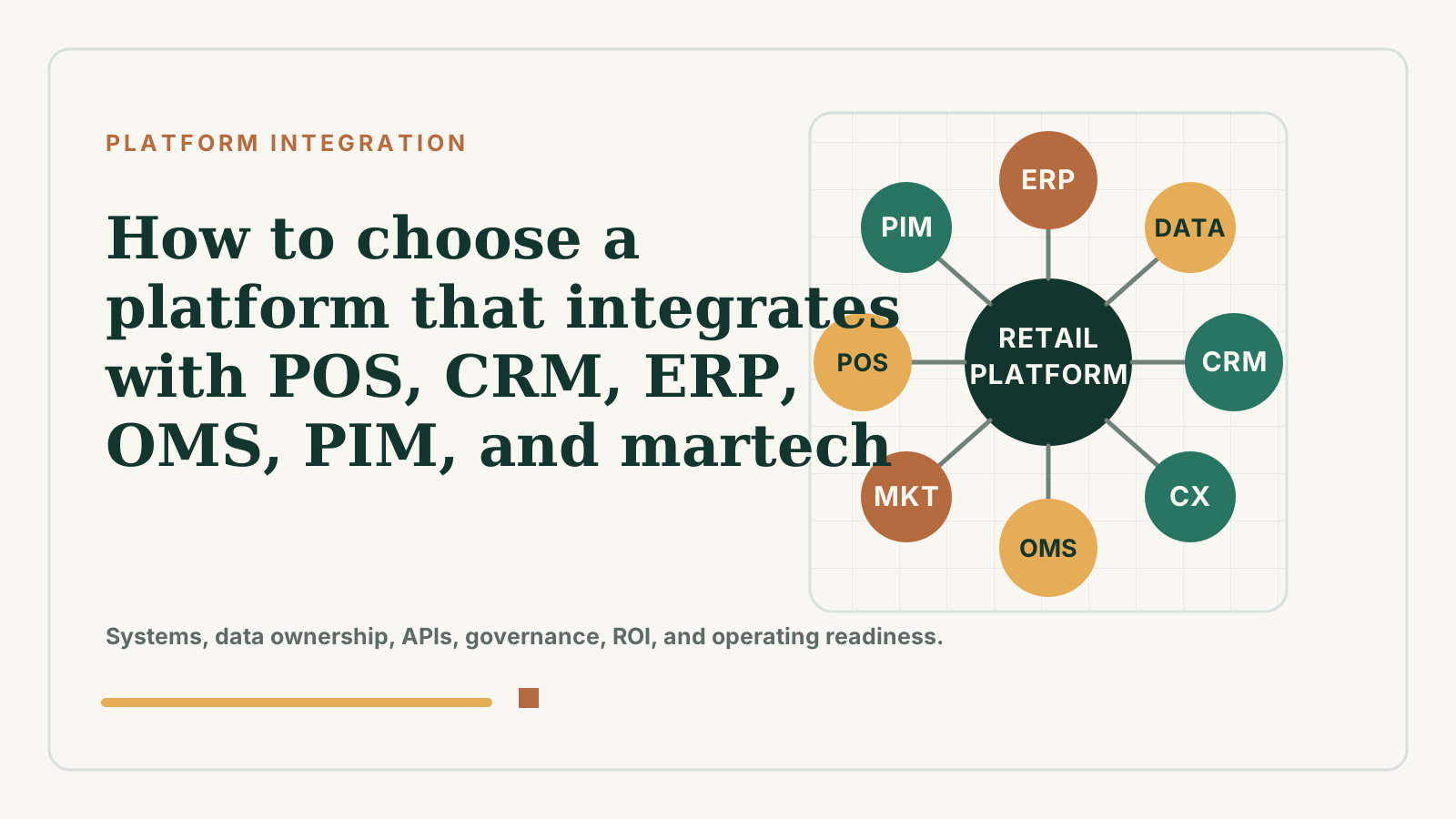
The better starting question is this: which business promises must the platform help the company keep? A customer expects accurate product information, current availability, consistent pricing, relevant messaging, smooth checkout, reliable fulfillment, clear returns, and informed service. Behind that experience sits a network of systems. POS may hold store sales and return activity. CRM may hold customer relationships and service history. ERP may hold financial, pricing, procurement, and inventory controls. OMS may orchestrate orders and fulfillment rules. PIM may structure product data. Martech may personalize campaigns and measure engagement. Data platforms and analytics tools may tie the story together.
If leadership does not define the role of each system, the platform decision becomes fragile. Teams may buy an impressive commerce, loyalty, CDP, or engagement platform and then discover that every improvement requires custom work, manual reconciliation, duplicated records, delayed approvals, or vendor negotiation. That is why integration belongs in the executive conversation from the start. It determines how fast the business can change, how accurately it can serve customers, and how confidently leaders can trust the numbers.
Start with operating scenarios, not connectors
A connector says two systems can exchange information. It does not prove that the exchange supports the business workflow. Before choosing a platform, evaluate the operating scenarios that matter most. For a retailer, those scenarios might include launching a new product, changing a price, publishing localized content, setting up a promotion, handling a store return, resolving a customer identity conflict, routing an order, managing out of stock substitutions, suppressing an ineligible customer offer, or explaining a revenue discrepancy after a campaign.
Trace each scenario from trigger to outcome. What starts the work? Which team owns the decision? Which systems are touched? Which data fields are required? Which system is authoritative? What must happen in real time and what can run in batch? Which exception path creates service tickets, lost sales, margin leakage, or manual cleanup? What evidence would prove that the new platform improved the flow?
This approach changes the vendor conversation. Instead of asking whether the platform integrates with ERP, the team asks how it handles pricing controlled by ERP when marketing wants same-day promotional agility. Instead of asking whether the platform integrates with PIM, the team asks how product attributes, media, translations, variant logic, and channel-specific content move into the customer experience. Instead of asking whether the platform integrates with CRM, the team asks how identity, consent, service history, loyalty status, and engagement data support a better customer decision.
The platform that looks strongest in a demo may not be the platform that handles these scenarios best. A disciplined evaluation makes vendors prove fit against operating reality, rather than only against a standard feature checklist.
Define source of truth before the integration map
Integration strategy starts with data ownership. If POS, CRM, ERP, OMS, PIM, ecommerce, and martech all hold overlapping records, the business needs rules for which system owns each decision. The answer may be different by domain. ERP may own financial truth. PIM may own product enrichment. OMS may own order state and fulfillment orchestration. CRM may own customer service context. POS may own store transaction facts. Martech may own campaign eligibility and engagement history. The commerce platform may own presentation, checkout, and customer interaction context.
The problem starts when those boundaries are assumed instead of decided. Product teams may treat PIM as the source of truth until merchandising edits copy directly in commerce. Finance may treat ERP pricing as authoritative until marketing creates discount rules in a campaign tool. Store operations may trust POS inventory until ecommerce promises availability from an OMS calculation. Customer service may rely on CRM while loyalty, ecommerce, and email platforms each hold different customer preferences.
Before the integration map is drawn, define the record domains that matter: product, price, inventory, customer, account, consent, order, promotion, payment, return, loyalty, fulfillment, and analytics events. For each domain, name the authoritative system, the owner, the allowed downstream consumers, the required freshness, the exception process, and the reporting rule. This is the operating foundation behind the data ownership argument in Retail Data Ownership: Why It Matters Before AI, Omnichannel, and ERP Change.
Without this work, the integration architecture can make bad data move faster. With it, the platform evaluation becomes sharper. The team can ask whether the vendor supports the necessary data contracts, APIs, events, transformations, audit trails, and governance controls around the records that carry business risk.
Evaluate API and event capability in business terms
Modern platform vendors often describe themselves as API-first, composable, extensible, cloud native, or headless. Those concepts matter, especially when a retail architecture needs flexibility across commerce, content, data, OMS, ERP, CRM, and martech. The MACH Alliance describes the importance of modular, API-first, cloud-native SaaS, and headless principles. Those principles can help teams avoid being trapped by rigid suites, but they do not remove the need for operating design.
Test API capability through business questions. Can the platform expose the data needed to create a single customer view? Can it consume product attributes from PIM without losing validation rules? Can it receive inventory availability from OMS or ERP at the frequency required by the customer promise? Can it pass order events to service, analytics, fulfillment, and finance without custom workarounds? Can it support loyalty, personalization, campaign suppression, and consent rules without duplicating decision logic across tools?
Event design is equally important. A platform that only supports point to point integration can become hard to operate as the business scales. Event-driven patterns can help when many systems need to react to the same business event, such as product published, inventory updated, order created, order cancelled, return completed, customer consent changed, or promotion activated. But events need ownership, naming standards, schema management, monitoring, and replay behavior. Otherwise the event layer becomes another source of confusion.
The executive takeaway is simple. Do not evaluate APIs as technical decoration. Evaluate them as the operating language of the business. A strong platform helps the organization express business events clearly, move data reliably, inspect failures, and change without breaking downstream teams.
Test each system role
Test each system in the ecosystem for its role in the customer promise. POS integration deserves more than transaction capture. Does the platform understand store returns, exchanges, associate activity, store inventory adjustments, and customer purchases that happen outside ecommerce? If a customer buys online and returns in store, can finance, CRM, loyalty, inventory, and analytics agree on what happened?
Test CRM integration around identity and service context. Can the platform distinguish households, accounts, loyalty members, anonymous shoppers, business buyers, and service contacts? Can consent and preferences flow reliably? Can customer service see enough order, inventory, product, and promotion context to resolve issues without switching across several systems? In B2B, can account hierarchy, contract terms, buyer roles, and negotiated pricing survive the handoff into commerce and martech?
Test ERP integration around the controls that protect the business. Pricing, tax, procurement, finance, item master, inventory valuation, payment reconciliation, and margin reporting often sit near ERP. If the platform needs flexibility, leaders need to decide where flexibility is allowed and where control remains strict. The platform cannot create a shadow financial model because the integration was inconvenient.
Test OMS integration around order state, routing, promise dates, substitutions, split shipments, cancellation, fraud holds, returns, and service visibility. Shopify's order management developer material is a helpful reminder that order workflows involve apps, fulfillment, orders, returns, and operational actions well beyond checkout. A platform that creates demand without reliable order orchestration can create customer frustration quickly.
Test PIM integration around product truth. Product attributes, media, variants, categories, compatibility, care instructions, sizing, warranties, translations, marketplace fields, and compliance claims need structure and ownership. This connects directly to Shopify Agentic Commerce Will Reward Stores With Better Product Truth. As AI-assisted shopping grows, weak product truth becomes more visible because more systems depend on clean product evidence.
Test martech integration around eligibility, orchestration, measurement, and restraint. The point is not to send more messages. It is to coordinate offers, content, audiences, suppression rules, consent, experimentation, personalization, and analytics. Adobe Experience Platform's source connector model and Google Analytics developer guidance both point to the same reality: marketing data only creates value when collection, integration, and activation are disciplined.
Use ROI to separate value from complexity
Integration work can become expensive quickly. Every platform wants to be connected. Every team wants its data represented. Every vendor can argue that its system is central. Leaders need a way to separate valuable complexity from expensive noise. ROI gives the conversation discipline, as long as it is framed through measurable levers instead of guaranteed promises.
Start by measuring current friction. How many manual hours are spent reconciling product, customer, inventory, order, or campaign data? How often do products launch late because attributes or approvals are missing? How many orders are delayed, cancelled, or escalated because availability, fulfillment, or customer data is wrong? How much vendor effort is required for routine changes? How often does leadership receive conflicting reports from commerce, CRM, ERP, POS, and analytics?
Then connect the platform decision to improvement levers. A better PIM and commerce integration may reduce product launch delays and content defects. A better OMS and commerce integration may reduce oversells, cancellations, and customer contacts. A better CRM and order integration may improve service resolution. A better martech and customer data integration may improve relevance while reducing discount waste. A better ERP integration may improve margin control and financial trust.
The business case also needs to include risk reduction. Some integration value appears as avoided rework, cleaner auditability, fewer one-off customizations, lower support burden, better vendor leverage, and a more maintainable architecture. Those benefits may not look as exciting as revenue lift, but they often determine whether the platform remains scalable after launch.
Governance is part of platform fit
A platform can be technically capable and still be a poor fit for the organization's governance maturity. A highly composable architecture can be powerful when the business has product owners, architecture standards, API governance, data ownership, observability, security controls, and strong delivery discipline. The same architecture can become expensive when every team buys tools independently, data contracts are informal, and no one owns the full customer promise.
Evaluate governance as part of platform fit. Who can add apps or integrations? Who approves changes to product data, price rules, identity rules, personalization logic, order routing, and analytics events? Which changes require QA? Which events require monitoring? Which vendors own which parts of the stack? What happens when an integration fails during peak trading? Who decides whether to fix, pause, roll back, or accept risk?
Omnichannel Is Not a Front-End Problem is relevant here. Omnichannel does not fail because the front end is unattractive. It fails when systems, data, ownership, and operations cannot keep the same promise across channels. Platform choice needs to make that promise easier to govern, not harder.
Ask vendors and implementation partners to show how the platform supports roles, permissions, audit trails, environments, release management, integration monitoring, data validation, and operational support. If the platform makes change easy but accountability unclear, the organization may move faster in the short term and accumulate risk in the long term.
The selection process
A strong platform selection process produces evidence rather than preference. First, define the business capabilities the platform must enable over the next 18 to 36 months. Second, identify the key operating scenarios that test those capabilities across POS, CRM, ERP, OMS, PIM, martech, analytics, stores, and service. Third, define source of truth and ownership for each major data domain. Fourth, ask vendors to demonstrate those scenarios with realistic integration assumptions.
Fifth, score the platform against operating fit: data model, API maturity, event support, implementation complexity, governance controls, ecosystem strength, vendor support, observability, security, extensibility, and cost to change. Sixth, pressure-test the implementation model. Which work is configuration? Which is integration? Which is custom? Which is partner-owned? Which is internal? Which decisions must be made before build? Seventh, build the business case around measurable improvement and risk reduction.
The final output needs to be an executive decision package: recommended platform, options considered, operating scenarios tested, integration risks, data ownership decisions, implementation assumptions, budget range, change impact, governance needs, and the first 90 days of work after selection. That package is stronger than a vendor scorecard alone because it connects the platform decision to how the business will actually run.
If your team is comparing platforms but the decision still feels abstract, a diagnostic call can help turn the conversation into evidence. Bring one or two operating scenarios, the systems involved, the current workarounds, and the business cost of delay or rework. That is enough to start pressure-testing whether the platform decision is really about technology, data, ownership, delivery, or the operating model around all of them.
Questions to ask before choosing the platform
- Which system owns product, price, inventory, customer, consent, order, promotion, return, and financial truth?
- Which customer promises require real time integration, and which workflows can tolerate scheduled syncs?
- Which operating scenarios need to be demonstrated before selection?
- Where will APIs, events, data contracts, audit trails, and integration monitoring be owned?
- Which platform capabilities reduce manual work, launch delays, reporting conflict, customer friction, or vendor dependency?
- What governance model will prevent the new platform from creating another layer of disconnected tools?
Related reading
Internal linking path for deeper context
Continue through these connected JM Digital Corp insights to move from platform selection into architecture, data ownership, and operating model decisions.
Research references
This article is grounded in current platform, standards, and industry material. The links below are included for readers who want source context behind the recommendations.
Need to pressure-test a platform decision?
JM Digital Corp helps leadership teams evaluate platform fit across ecommerce, POS, CRM, ERP, OMS, PIM, martech, data ownership, integration strategy, operating model, governance, and ROI before the commitment becomes expensive.
Book a diagnostic call