
In one anonymized retail engagement, the business was struggling to give customers a reliable promise across digital and store channels. Inventory accuracy mattered, but the larger question was how stock movement, reservations, order orchestration, service visibility, and exception ownership worked together.
This case study is anonymized. Client name, implementation partner names, proprietary architecture details, and exact commercial figures are generalized to protect confidentiality. The operating pattern, diagnostic method, and decision framework reflect the type of work JM Digital Corp performs with retail and digital commerce leadership teams.
Executive Summary
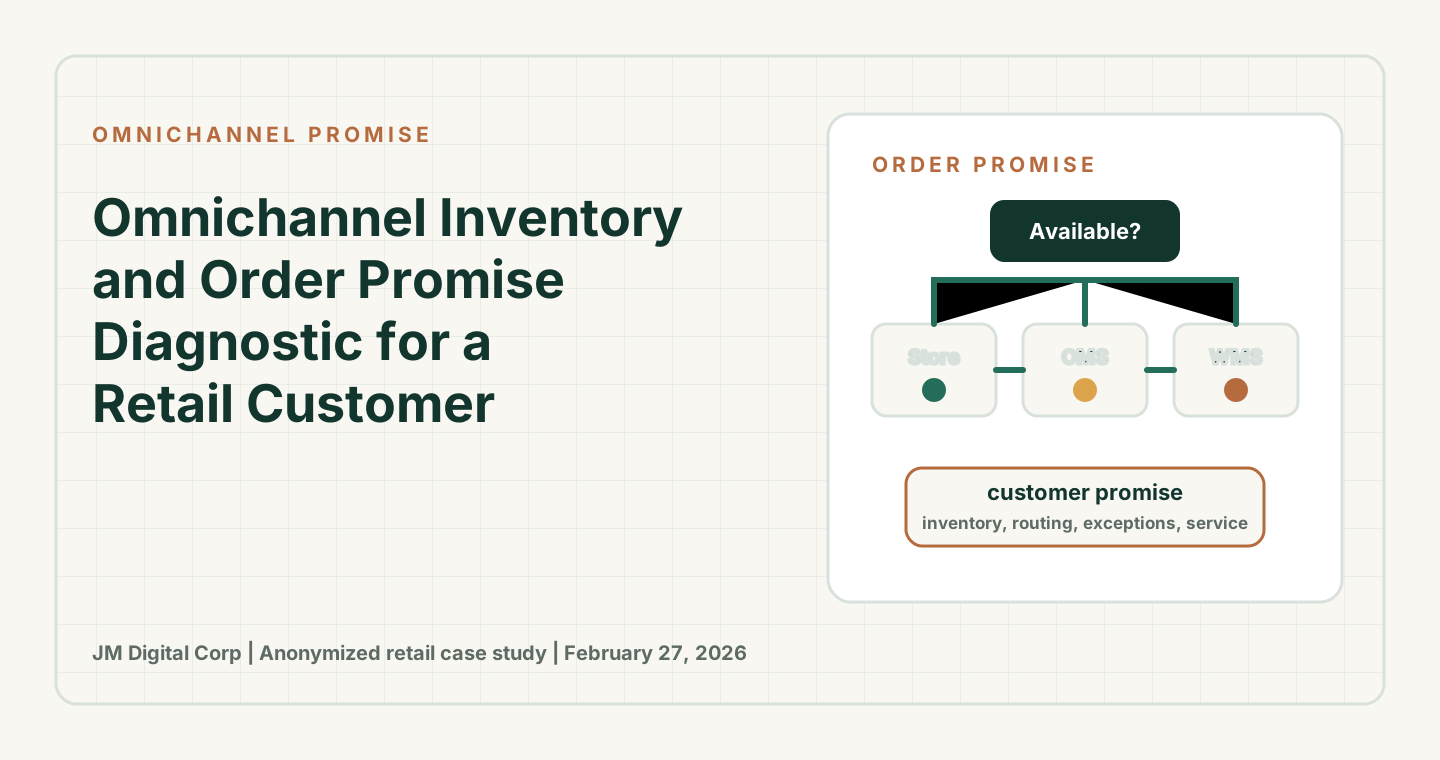
Omnichannel OperationsThe client needed to understand why inventory and order promises were not consistently trusted across channels. The review traced the customer promise through ecommerce, POS, OMS, ERP, WMS, stores, and service teams to identify where data freshness, reservation logic, exception ownership, and operational controls needed attention.
Client context
The customer served shoppers through digital and store channels. The business wanted customers to trust product availability, order status, fulfillment timing, pickup options, returns, and service answers. Those experiences looked simple from the outside, but they depended on many moving parts behind the scenes.
Inventory information changed through store sales, online orders, returns, transfers, warehouse activity, cancellations, adjustments, reservations, damaged goods, and manual corrections. Order state changed through checkout, fraud review, routing, fulfillment, shipment, cancellation, return, refund, and customer service intervention. The challenge was that the customer promise depended on how those events were represented across ecommerce, POS, OMS, ERP, WMS, stores, service, and analytics.
The review centered on the omnichannel inventory and order promise. Leadership needed the operating path to be visible enough to know what to stabilize first.
The challenge
Inventory problems are often described as accuracy problems. Accuracy matters, but the customer promise depends on more than accuracy. It depends on timing, reservations, availability rules, fulfillment options, store behavior, cancellation handling, returns, customer communication, and service visibility. A number can be accurate in one system and still create a poor customer experience if the promise logic is not clear.
The team had to understand where the promise broke. Was the issue stale store data? Incorrect reservation behavior? Missing safety stock logic? Returns not restocking quickly enough? Order routing rules? Manual adjustments? Warehouse status? Service teams lacking visibility? Or reporting that combined several states into one misleading metric?
The review separated those possibilities and showed how they interacted.
Signals of deeper operating risk
- Inventory accuracy discussions focused on one system while the customer promise depended on several systems and teams.
- Store activity, warehouse movement, ecommerce demand, reservations, cancellations, and returns were not always represented consistently.
- Customer service needed clearer visibility into order state, fulfillment decisions, and exception ownership.
- Operational teams were correcting problems manually after the customer promise had already been affected.
- Executives needed to know whether the fix required platform change, integration change, process change, governance change, or all of the above.
Approach
Define the customer promise
Clarified what the customer expected to know about availability, delivery, pickup, cancellation, returns, and service status.
Trace one SKU family
Followed inventory movement across stores, warehouse, ecommerce, OMS, ERP, POS, and service workflows.
Map availability logic
Reviewed on-hand, reserved, safety stock, damaged, in transit, pickup, ship-from-store, and unavailable inventory rules.
Inspect exception paths
Identified what happened when availability, order state, or fulfillment status disagreed across systems.
Connect to service impact
Mapped how order and inventory issues appeared to customer service, stores, ecommerce, and reporting teams.
Prioritize stabilization
Built a short list of changes that would improve trust before larger platform or fulfillment work.
The solution design
The review started by defining the customer promises that mattered most. For example: available online, available for pickup, available to ship, order confirmed, order delayed, order cancelled, return received, refund initiated, and service resolution. Each promise was then traced through the systems and teams involved.
The review inspected update frequency, reservation logic, order routing, store adjustments, warehouse movement, returns, damaged inventory, customer communication, service visibility, analytics events, and exception ownership. The point was not to blame a system. It was to find where the operating model lacked enough clarity or control.
The final recommendation separated quick stabilization moves from longer-term architecture moves. Some issues could be improved by clearer ownership, better exception handling, reporting cleanup, and rule documentation. Other issues required integration changes, OMS logic changes, POS or WMS alignment, or platform roadmap decisions.
Business impact logic
The business case connected inventory and order promise improvement to customer confidence, conversion, reduced cancellations, fewer service contacts, lower manual correction effort, cleaner reporting, and better store and fulfillment execution. The customer did not need vague promises. They needed a way to track whether the operating changes reduced real friction.
The review defined metrics that leadership could actually use: cancellation rate linked to availability issues, customer contacts related to order status, manual inventory adjustments, delayed fulfillment exceptions, return restock timing, out-of-stock display accuracy, and reconciliation effort. These metrics made the value case easier to discuss.
Risk also became easier to manage. When the business understands who owns the promise, who owns the exception, and where the data comes from, it can respond faster during peak trading and avoid scaling weak rules into larger volume.
What changed after the review
By the end of the review, leadership had an inventory and order promise map, a list of failure points, a system ownership view, an exception ownership model, a metrics set, and a prioritized stabilization path.
The finding was straightforward: omnichannel performance was not primarily a front-end question. It was a connected operating question across stores, warehouse, ecommerce, systems, data, and service. That made future platform, OMS, inventory, and fulfillment decisions easier to frame.
Most importantly, the client had a way to improve the reliability of customer promises without waiting for a full transformation program to finish.
What changed after the review
Promise map
A customer-facing view of how availability, order status, fulfillment, returns, and service answers were created.
Failure path register
A clear list of where the promise could break and which team or system owned the next move.
Stabilization metrics
A measurable set of customer, operational, service, and reconciliation indicators.
90-day action path
A sequenced plan for ownership, rule cleanup, integration work, visibility, and governance.
When this case study is relevant
- Customers see availability or delivery promises that stores, warehouses, or service teams cannot confidently explain.
- POS, OMS, ERP, WMS, ecommerce, and service systems disagree on inventory, order, or return status.
- The business is debating real-time inventory without defining which promise actually needs real-time behavior.
- Manual corrections are happening after customer confidence has already been damaged.
- Leadership needs to know whether the fix is platform, integration, data, process, or ownership related.
Related reading
Read the strategy behind this case study
These JM Digital Corp insights expand the architecture, data ownership, operating model, and platform thinking behind this diagnostic approach.
Need to pressure-test a similar decision?
JM Digital Corp helps retail and digital commerce leadership teams evaluate architecture, systems, data ownership, platform fit, governance, vendor scope, operating model decisions, and ROI before the commitment becomes expensive.
Book a diagnostic call