
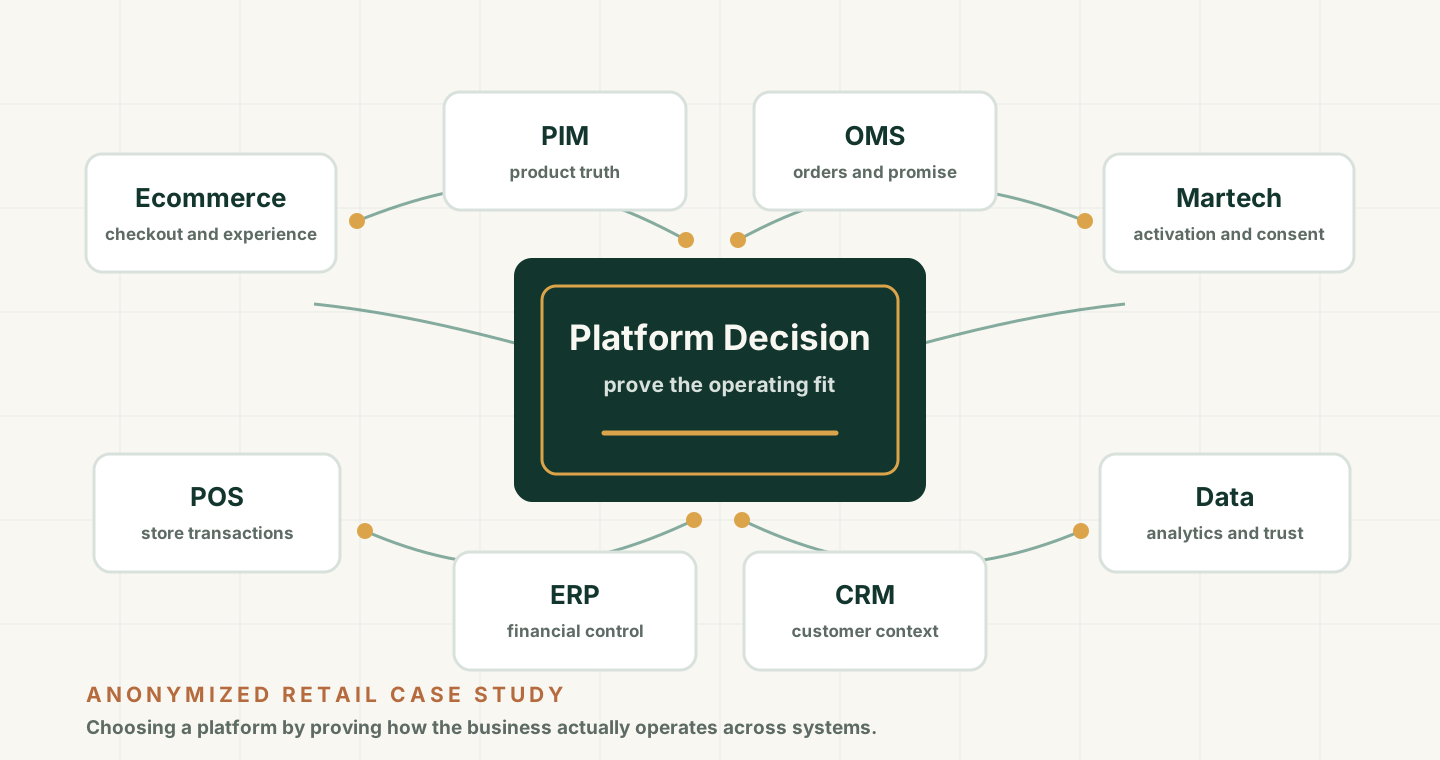
In one anonymized retail engagement, the client was preparing for a major platform decision. Vendor selection mattered, but the bigger test was whether ecommerce, POS, CRM, ERP, OMS, PIM, martech, analytics, and operating ownership could work together well enough to support growth without adding another layer of complexity.
This case study is anonymized. Client name, implementation partner names, proprietary architecture details, and exact commercial figures are generalized to protect confidentiality. The operating pattern, diagnostic method, and decision framework reflect the type of work JM Digital Corp performs with retail and digital commerce leadership teams.
Executive Summary
Platform Integration DiagnosticThe client needed to choose and sequence platform work across commerce, POS, CRM, ERP, OMS, PIM, martech, and data platforms. The advisory work moved the conversation away from a connector checklist and toward operating evidence: system ownership, business scenarios, integration risks, data governance, delivery sequencing, and measurable value.
Client context
The customer was a retail organization with a growing digital commerce footprint, established store operations, and a platform ecosystem that had evolved around urgent business needs. Ecommerce, store transactions, product data, inventory availability, customer information, order orchestration, marketing activation, and reporting all existed, but the operating model around them was not as clear as the business needed it to be.
Leadership was considering a meaningful platform change. The team wanted better integration across POS, CRM, ERP, OMS, PIM, martech, and analytics. The immediate question sounded technical: which platform do we choose, and how well does it integrate with the tools we already use? The more important question was operating-oriented: which business promises must the platform help us keep, and which systems need to own the data and decisions behind those promises?
The customer did not need another generic transformation roadmap. They needed a way to evaluate platform fit against the way the business actually ran. That meant starting with operating scenarios, not vendor demonstrations. It also meant connecting architecture decisions to business outcomes such as launch speed, reduced manual work, better customer confidence, cleaner reporting, lower operating risk, and more disciplined vendor spend.
The challenge
The platform conversation was becoming crowded. Different teams saw different symptoms. Ecommerce wanted more agility. Merchandising wanted cleaner product publishing. Store operations wanted inventory and return activity to reconcile more reliably. Marketing wanted better customer segmentation and campaign activation. Finance wanted stronger alignment between platform decisions, controls, reporting, and margin impact. Technology wanted fewer brittle integrations and a more maintainable architecture.
Each concern was valid, but the symptoms were connected. A product publishing delay involved more than PIM. It involved merchandising workflow, content ownership, ecommerce presentation, translation or channel logic, QA, and sometimes ERP item setup. An inventory trust issue involved more than OMS. It involved POS activity, inventory rules, safety stock, warehouse activity, ecommerce promise logic, order routing, and exception handling. A customer identity issue involved more than CRM. It involved ecommerce accounts, POS customers, loyalty, service records, consent, martech audiences, and reporting definitions.
The risk was that the business would choose a platform based on feature coverage while leaving the underlying ownership model unresolved. In that scenario, the new platform might appear stronger in a demo but still inherit the same operating friction after implementation.
The challenge was framed this way: the customer needed to choose a platform and integration path that could support the operating model they wanted, not merely connect to the systems they already had.
Symptoms that signaled integration risk
- Platform decisions were being evaluated through feature lists before the business had agreed on system-of-record ownership.
- Product, inventory, customer, order, promotion, and reporting data crossed several platforms with unclear exception ownership.
- Operational teams relied on manual reconciliation when information disagreed across ecommerce, stores, CRM, ERP, OMS, PIM, or analytics.
- Vendor discussions focused on connector availability more than real business scenarios, data contracts, latency needs, monitoring, and support model.
- Leadership needed a stronger line of sight between architecture work and ROI levers such as speed, risk reduction, customer confidence, margin protection, and lower operating waste.
The advisory product used
JM Digital applied a platform integration readiness diagnostic. The product is designed for leadership teams that need to make a platform decision across connected retail systems before the cost of the wrong decision becomes expensive. It is not a vendor selection template by itself. It is a structured way to turn platform selection into an evidence-based operating decision.
The review examined four layers. First, the business layer: which customer promises, operating outcomes, and leadership decisions mattered most. Second, the systems layer: which platforms touched product, customer, inventory, order, price, promotion, finance, consent, and analytics data. Third, the ownership layer: who owned the decisions, exceptions, approvals, and service impact when something broke. Fourth, the value layer: how the recommended path would reduce risk, improve speed, strengthen operating confidence, or create measurable business value.
The work gave the customer a clearer language for evaluating platforms. Instead of asking whether a vendor had a POS connector, the team could ask how store transactions, returns, inventory adjustments, customer identity, loyalty activity, and reporting events would flow. Instead of asking whether the platform integrated with PIM, the team could test how attributes, media, product variants, approvals, localization, and channel-specific content would reach the customer experience. Instead of asking whether the platform worked with martech, the team could inspect eligibility, consent, audience rules, suppression, measurement, and campaign feedback loops.
Approach
Collect operating evidence
Reviewed the platform ecosystem, roadmap pressure, known pain points, ownership concerns, and leadership decisions waiting for clarity.
Trace business scenarios
Mapped product publishing, inventory availability, order creation, return activity, customer identity, promotion eligibility, and reporting flows across systems.
Define system ownership
Separated authoritative records from downstream consumers so the customer could see where data, process, and decision rights were unclear.
Score platform fit
Converted operating needs into platform evaluation criteria covering APIs, events, governance, observability, support model, implementation complexity, and cost to change.
Build the business case
Connected integration decisions to measurable outcomes such as fewer manual reconciliations, better launch readiness, improved customer trust, cleaner reporting, and lower rework.
Sequence the next 90 days
Created a sequenced path that separated urgent stabilization work from platform selection, partner scope, governance decisions, and implementation planning.
Operating scenarios we used to test fit
The strongest part of the diagnostic was the shift from general platform opinions to specific scenarios. The team selected business events that crossed multiple systems and created real operational consequences. Each scenario was traced from the initial trigger to the customer, financial, operational, and reporting outcome.
One scenario focused on product publishing. The question went beyond whether the platform could display product data. The review inspected where item setup began, which attributes were mandatory, how PIM enrichment moved downstream, how channel-specific rules were handled, which approvals were required, how content reached ecommerce, how merchandising changes were tested, and what happened when a product was visible before the full operating record was ready.
A second scenario focused on inventory availability. The team traced how inventory changed across stores, warehouses, ecommerce, OMS, ERP, and POS. It looked at update frequency, reservations, safety stock, manual adjustments, unavailable inventory, cancellation paths, and who owned the customer conversation when availability was wrong.
A third scenario focused on customer identity and campaign eligibility. The review examined how ecommerce accounts, POS transactions, CRM records, loyalty identifiers, service history, consent, martech audiences, and analytics events aligned. That showed leadership why personalization and retention goals depended on system ownership, data governance, and campaign execution working together.
These scenarios made the platform decision more concrete. They showed which vendor capabilities mattered, which integration assumptions were risky, which workflows needed ownership changes, and which issues had to be stabilized before implementation.
Source-of-truth decisions created during the diagnostic
| Domain | Decision to clarify | Risk if unclear |
|---|---|---|
| Product | Which system owns attributes, media, variants, categorization, compliance fields, and channel enrichment? | Late launches, inconsistent product pages, manual edits, weak AI and search readiness. |
| Inventory | Which system owns available-to-promise logic across stores, warehouses, ecommerce, and fulfillment? | Oversells, cancellations, service escalations, poor customer confidence. |
| Customer | Which system owns identity, consent, service context, loyalty status, account hierarchy, and suppression rules? | Fragmented customer view, weak personalization, compliance risk, poor service resolution. |
| Order | Which system owns order state, fulfillment routing, cancellation, returns, refund visibility, and customer service status? | Conflicting records, manual follow-up, delayed resolution, unreliable reporting. |
| Promotion | Which system owns eligibility, discount rules, stacking logic, channel exceptions, and finance treatment? | Margin leakage, customer complaints, reporting disputes, rework across marketing and finance. |
| Analytics | Which events are trusted for executive reporting, campaign measurement, inventory decisions, and operational performance? | Conflicting dashboards, slow decisions, poor confidence in platform ROI. |
The solution design
The recommended solution was not a single platform answer. It was a decision framework the customer could use to select and sequence platform work with more confidence. The framework separated platform capability from operating readiness so leaders could see what the vendor needed to provide, what the implementation partner needed to build, and what the internal organization needed to decide.
The solution included a source-of-truth model for major data domains, an integration risk map, a scenario-based platform scorecard, and a governance model for decisions that crossed business and technology teams. It also identified where event-driven integration mattered, where scheduled data movement was acceptable, where real-time API behavior affected the customer promise, and where manual fallback or human review needed to remain in place during transition.
The customer also needed a cleaner way to discuss cost. The business case was separated into three categories. The first was value creation: faster product launches, better conversion confidence, more relevant campaigns, and stronger service interactions. The second was cost reduction: fewer manual reconciliations, fewer duplicate data corrections, lower support burden, and less custom work caused by unclear ownership. The third was risk reduction: fewer customer-impacting failures, cleaner auditability, better vendor accountability, and more reliable executive reporting.
This gave leadership a more balanced view of ROI. The platform decision was no longer framed only as a software purchase. It became a business operating decision with technology, process, data, governance, vendor, and financial implications.
Governance and ownership recommendations
The review showed that integration risk often increases when every team optimizes its own tool without one shared view of the customer promise. The recommended ownership model focused on business events as well as systems. Product published, inventory changed, order created, return completed, customer consent updated, promotion activated, and campaign audience refreshed each needed a named owner, data contract, exception path, and monitoring expectation.
The customer needed governance that supported speed without recreating the same complexity inside a newer platform stack. The recommendation was to define clear decision rights around high-risk domains and keep lower-risk changes lighter. For example, visual content updates might follow one path, while pricing, promotion eligibility, inventory promise logic, customer consent, and order routing needed stronger review and traceability.
Vendor accountability was also part of the recommendation. When a platform depends on implementation partners, middleware, apps, managed services, and internal teams, leaders need to know who owns the outcome when something fails. The review separated configuration responsibility, integration responsibility, data responsibility, operational support, business decision ownership, and executive escalation.
Business impact logic
Because the client details are confidential, this case study does not publish exact financial figures. The business impact logic, however, is clear: platform integration quality affects growth, cost, risk, and operating confidence.
For growth, the diagnostic connected platform fit to faster launches, stronger product discovery, better inventory promise accuracy, richer customer data, and cleaner campaign activation. For cost, it identified where manual reconciliation, duplicate system updates, implementation rework, support effort, vendor dependence, and brittle point-to-point integrations were creating avoidable drag. For risk, it clarified where unclear source-of-truth ownership, weak exception handling, poor observability, inconsistent access control, and conflicting reporting could create customer, financial, or operational exposure.
The strongest outcome was confidence. Leadership could discuss the platform decision with a clearer view of the tradeoffs. The customer had a stronger basis for vendor conversations, partner scope, internal readiness work, and sequencing. The business could see which issues needed to be fixed before build, which platform capabilities were truly differentiating, and which constraints were operating model decisions disguised as technology requirements.
What changed after the review
Executive decision package
A concise view of platform options, integration risks, business scenarios tested, operating dependencies, and decisions requiring leadership alignment.
Source-of-truth model
An ownership view across product, price, inventory, customer, order, promotion, finance, consent, fulfillment, and analytics domains.
Integration readiness scorecard
A way to score platform fit against APIs, events, data contracts, latency, exception handling, monitoring, security, governance, support, and cost to change.
90-day action path
A sequence of stabilization work, ownership decisions, vendor questions, scenario tests, and implementation planning priorities before major spend.
Why this mattered
The customer was not lacking ambition. The risk was that ambition could turn into expensive platform activity without enough operating clarity. A new platform can accelerate a strong operating model, but it can also amplify confusion if the business has not decided how systems, data, owners, vendors, and teams need to work together.
The platform conversation became more honest. Leadership could avoid choosing based only on a compelling vendor demo. Technology, ecommerce, stores, marketing, finance, and operations gained a shared language for the decision. Most importantly, platform architecture was connected to the business outcomes leaders cared about: better customer experience, faster change, more reliable reporting, less avoidable work, stronger risk management, and better ROI discipline.
This is the central lesson for scaling retail teams. Integration is about moving data between platforms and making sure the business can keep the promises those platforms represent.
When this case study is relevant
- Your team is choosing or replacing a commerce, CRM, ERP, OMS, PIM, CDP, loyalty, martech, middleware, or data platform.
- Executive leaders are receiving different explanations for the same problem from technology, ecommerce, stores, operations, marketing, finance, or vendors.
- Customer-facing issues are being blamed on the front end, but the root cause appears to involve product data, inventory, orders, customer identity, promotions, fulfillment, or reporting.
- Vendor demos look promising, but the organization has not pressure-tested real operating scenarios across the full ecosystem.
- The business needs a credible ROI story that connects platform investment to growth, cost, risk, speed, customer confidence, and operating resilience.
Related reading
Read the strategy behind this case study
These insights expand the platform integration, data ownership, and operating model thinking behind the diagnostic approach.
Need to pressure-test a platform decision?
JM Digital Corp helps retail and digital commerce leadership teams evaluate platform fit across ecommerce, POS, CRM, ERP, OMS, PIM, martech, data ownership, integration strategy, operating model, governance, vendor scope, and ROI before the commitment becomes expensive.
Book a diagnostic call