
In one anonymized retail engagement, leadership wanted stronger AI, personalization, omnichannel execution, and reporting. The constraint sat in ownership: product, customer, inventory, order, consent, promotion, and analytics data all influenced decisions, but accountability was not clear enough to support more automation.
This case study is anonymized. Client name, implementation partner names, proprietary architecture details, and exact commercial figures are generalized to protect confidentiality. The operating pattern, diagnostic method, and decision framework reflect the type of work JM Digital Corp performs with retail and digital commerce leadership teams.
Executive Summary
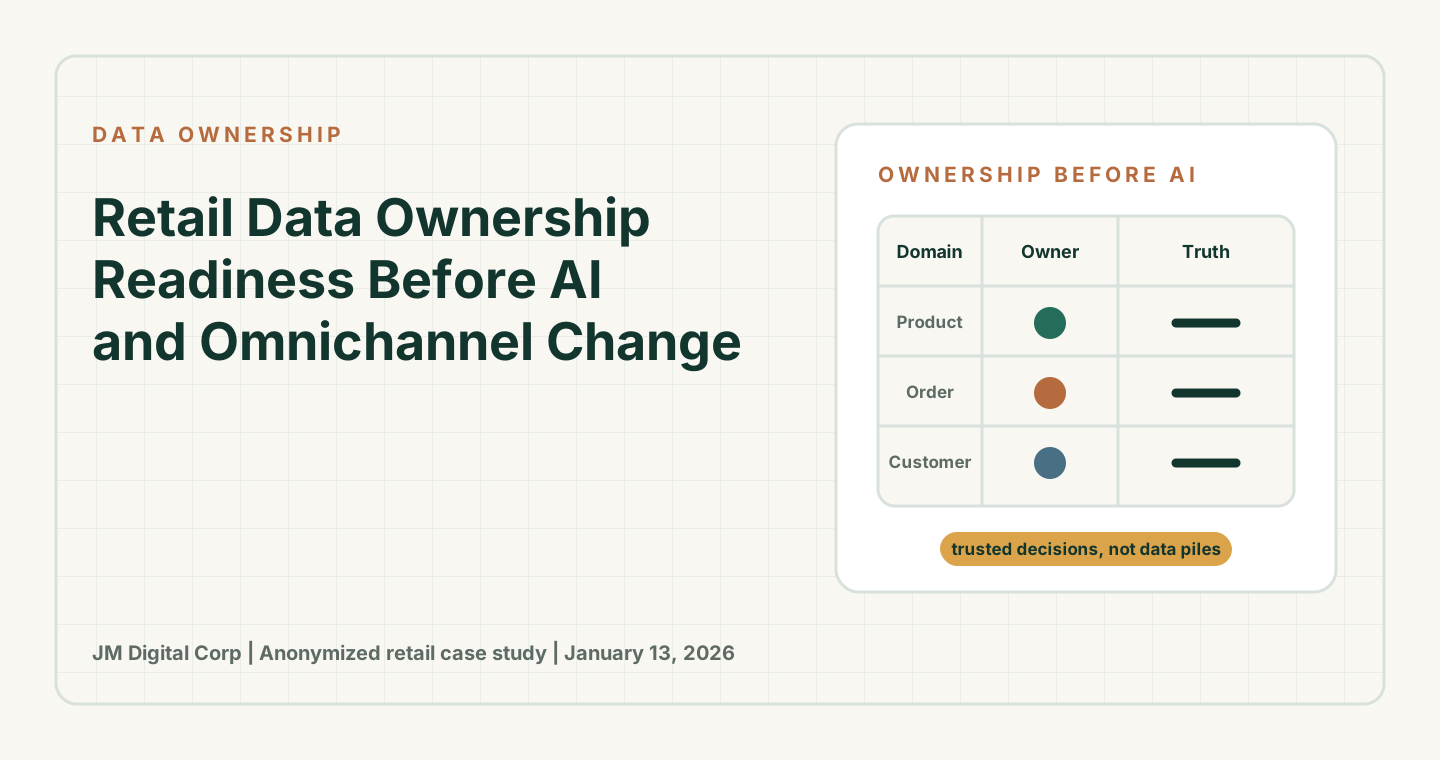
Data OwnershipThe client was investing in AI, personalization, omnichannel operations, and reporting, but several business domains still lacked accountable ownership. The review defined authoritative systems, decision owners, exception paths, freshness rules, and reporting definitions before more automation increased the cost of ambiguity.
Client context
The client had invested in the systems a modern retailer would expect: product data, commerce, stores, customer records, marketing tools, order management, analytics, and enterprise controls. Technology was present. What was missing was agreement on which system carried the operating truth for a specific decision.
This became more urgent as leadership explored AI and omnichannel improvement. AI depends on trustworthy inputs. Omnichannel depends on consistent customer promises. Personalization depends on identity, consent, product, behavior, and offer data that can be used responsibly. Reporting depends on shared event definitions. When ownership is unclear, every advanced capability inherits the same weakness.
The engagement was scoped as a data ownership readiness review. This was not about creating a heavy governance program. It was about making ownership explicit enough for teams to move faster with less rework and better confidence.
The challenge
The customer's teams were often debating outputs without first agreeing on inputs. Product teams trusted one view of product readiness. Marketing trusted another view of audience eligibility. Store and ecommerce teams had different views of inventory behavior. Customer service could not always see the full relationship across digital, store, loyalty, and support interactions. Executives received reporting that was directionally helpful but not always trusted enough for fast decisions.
The danger was that new AI or omnichannel tooling would move faster than governance. Automation can make unclear ownership more expensive because bad assumptions travel quickly. A personalization system can use stale or incomplete preferences. An AI assistant can answer from weak product truth. An inventory promise can look confident while the underlying availability logic is disputed. A dashboard can make a decision look precise while the event definition is inconsistent.
Before scaling new capabilities, the team had to decide which data domains mattered most, where authority belonged, and which exceptions needed named ownership.
Signals of deeper operating risk
- Different systems carried overlapping customer, product, inventory, order, or campaign records without one agreed source of truth.
- Reporting confidence depended on who produced the dashboard rather than a shared definition of the underlying business event.
- AI and personalization ideas were moving faster than the organization's ability to explain which data could be trusted.
- Consent, preference, loyalty, ecommerce, POS, CRM, and service context were not aligned enough to support confident customer decisions.
- Executives needed to know what to fix before adding more AI, CDP, personalization, or omnichannel capability.
Approach
Identify critical domains
Focused on product, customer, inventory, order, price, promotion, consent, loyalty, fulfillment, returns, and analytics events.
Name authoritative systems
Clarified which systems owned each record, which systems consumed it, and where business decisions belonged.
Map exception ownership
Defined who owns the decision when records disagree, data is stale, or a customer-facing issue depends on conflicting sources.
Connect to AI readiness
Translated ownership gaps into AI risks such as weak product truth, fragmented identity, unreliable recommendations, and poor eval data.
Build reporting definitions
Documented how key events needed to be represented for executive, operational, campaign, and customer-service reporting.
Prioritize the next 90 days
Sequenced high-value ownership decisions before major AI, omnichannel, CDP, or analytics investment.
The solution design
JM Digital built the diagnostic around business domains, not tool names. The team reviewed product, price, promotion, inventory, order, customer, consent, loyalty, return, fulfillment, and analytics events. For each domain, the diagnostic identified the authoritative system, accountable business owner, downstream consumers, required freshness, exception path, reporting definition, and AI readiness risk.
That distinction changed the conversation. Product truth could be separated from product presentation. Customer identity could be separated from campaign audience logic. Inventory on hand could be separated from available-to-promise. Order state could be separated from customer service visibility. Campaign eligibility could be separated from financial treatment. Teams could stop forcing one system to answer every question.
The ownership model also gave leadership a sequencing tool. Some domains were urgent because they blocked customer trust. Some were urgent because they created risk. Some mattered, but could wait. This allowed the customer to prioritize the data work that would unlock near-term AI and omnichannel value.
Business impact logic
The data ownership work created value by reducing ambiguity. When teams know which system owns which decision, they spend less time reconciling conflicting records. When exception ownership is clear, customer issues resolve faster. When reporting definitions are shared, executives can make decisions with less debate. When product and customer truth improve, AI and personalization have a stronger foundation.
The ROI logic focused on avoided waste and improved confidence. Avoided waste included fewer duplicate corrections, less manual reporting reconciliation, lower support effort, fewer campaign mistakes, fewer product launch defects, and less downstream rework. Improved confidence included better customer decisions, better executive reporting, and stronger readiness for AI-enabled workflows.
The review made one point difficult to ignore: data ownership is not a back-office concern. It affects growth, customer experience, risk, and operating leverage.
What changed after the review
By the end of the review, leadership had a domain ownership model, a source-of-truth decision table, a data risk map, a reporting definition backlog, and a 90-day action plan. The plan prioritized the ownership decisions with the highest impact on customer experience, AI readiness, omnichannel execution, and executive confidence.
That gave the teams a better way to evaluate future technology decisions. Instead of buying AI or data tools to compensate for unclear ownership, leadership could first decide what the business needed to trust. Platform, vendor, analytics, and AI discussions became more grounded.
Instead of a theoretical governance model, the client had a working management tool for deciding which data domains deserved attention before automation and omnichannel ambition scaled.
What changed after the review
Domain ownership model
A working view of authoritative systems, owners, downstream consumers, freshness needs, and exception paths.
AI readiness risk map
A clear view of which data gaps would weaken AI, personalization, agentic commerce, and operational automation.
Reporting definition backlog
A prioritized list of business events and metrics that needed shared definitions.
90-day action plan
A sequenced path for ownership decisions, governance moves, and high-value cleanup.
When this case study is relevant
- Your AI or personalization plans depend on product, customer, consent, inventory, or order data that teams do not fully trust.
- POS, ecommerce, CRM, loyalty, OMS, ERP, martech, and analytics systems all carry overlapping records.
- Reporting debates slow executive decisions because dashboards do not share the same event definitions.
- Customer service, marketing, ecommerce, stores, and finance each see a different version of the customer or order.
- The team needs an ownership model before committing to AI, CDP, data platform, or omnichannel spend.
Related reading
Read the strategy behind this case study
These JM Digital Corp insights expand the architecture, data ownership, operating model, and platform thinking behind this diagnostic approach.
Need to pressure-test a similar decision?
JM Digital Corp helps retail and digital commerce leadership teams evaluate architecture, systems, data ownership, platform fit, governance, vendor scope, operating model decisions, and ROI before the commitment becomes expensive.
Book a diagnostic call