
In one Shopify retail engagement, the client wanted to prepare for AI shopping agents and assistant-led discovery. The review focused on product truth, PDP evidence, policy clarity, structured data, and the ownership needed to keep those signals current.
This case study is anonymized. Client name, implementation partner names, proprietary architecture details, and exact commercial figures are generalized to protect confidentiality. The operating pattern, diagnostic method, and decision framework reflect the type of work JM Digital Corp performs with retail and digital commerce leadership teams.
Executive Summary
Shopify Agentic CommerceThe client wanted to improve Shopify readiness for agentic commerce and AI-assisted product discovery. The review evaluated product pages, product data, evidence quality, reviews, policies, structured attributes, merchandising workflow, analytics signals, and ownership so the team could prioritize improvements that made products easier to understand and trust.
Client context
The customer operated on Shopify and had a familiar ecommerce challenge. Product pages existed, traffic existed, merchandising effort existed, and some conversion improvement work had already happened. But the team wanted to understand whether the store was ready for a future where AI assistants, agentic shopping flows, search tools, and comparison experiences would rely more heavily on structured product evidence.
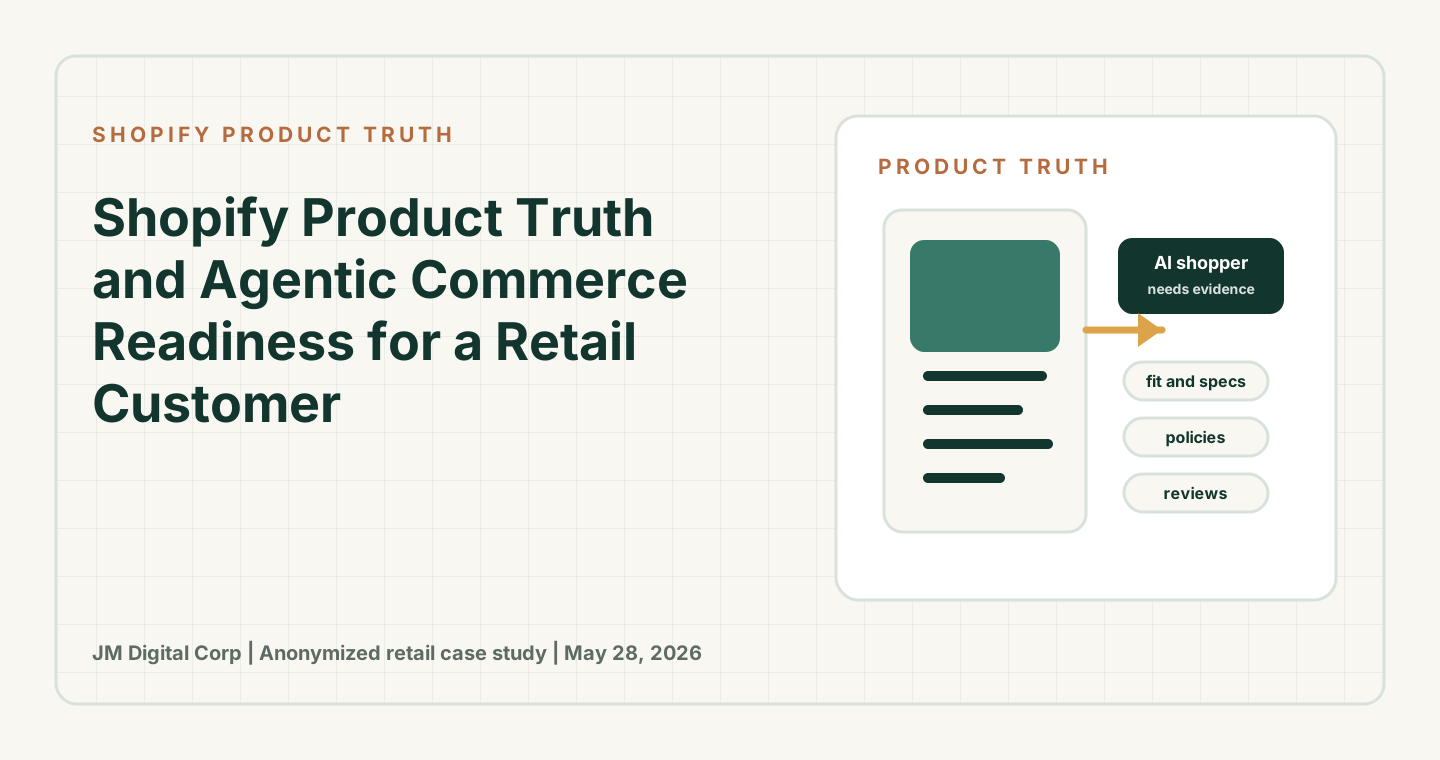
Attractive pages were not enough. The pages also had to answer the questions a cautious buyer or an AI shopping agent would ask. Product truth included attributes, media, materials, sizing, compatibility, use cases, limitations, care instructions, shipping, returns, warranty, reviews, FAQs, and policy context.
The work was framed as a Shopify product truth and agentic commerce readiness review. PDP improvement had to become more operational and measurable.
The challenge
Many ecommerce teams improve product pages by rewriting descriptions, adding more brand language, or adjusting layout. Those actions can help, but they do not solve weak product truth. A product page earns its keep when it reduces uncertainty. What is it made of? Who is it for? What does it fit? What problem does it solve? What are the dimensions? What is included? What happens if it does not work? How does it compare? What proof supports the claim?
AI-assisted discovery raises the standard because assistants need evidence to answer questions reliably. Vague product copy can sound polished but fail to support machine-readable interpretation. Missing attributes, weak media, unclear policies, thin reviews, inconsistent variants, or unstructured FAQs make the product harder to recommend with confidence.
The team needed to identify which product truth gaps were most likely to affect conversion, service effort, return risk, and future AI readiness.
Signals of deeper operating risk
- Important product questions were answered inconsistently across PDP content, images, reviews, policies, service scripts, and merchandising notes.
- Product attributes were not structured enough to support comparison, AI interpretation, filtering, search, and evidence-based recommendations.
- Policies, shipping, returns, sizing, compatibility, materials, use cases, and care details were not consistently connected to product pages.
- The team treated PDP improvement as copywriting instead of product truth, operating ownership, and customer decision support.
- Leaders needed a way to prioritize product content work by commercial impact, not subjective preference.
Approach
Select priority products
Started with commercially important products and categories where uncertainty could affect conversion or service contacts.
Collect customer questions
Reviewed PDP gaps through buyer questions, reviews, support themes, policy needs, attributes, media, and comparison needs.
Score product truth
Evaluated title, description, attributes, media, variants, sizing, compatibility, policies, evidence, reviews, and structured data.
Map ownership
Clarified who owned product facts, merchandising copy, media, policy answers, service scripts, analytics feedback, and updates.
Prioritize conversion support
Separated improvements that gave shoppers confidence from cosmetic edits that did not reduce uncertainty.
Build a repeatable checklist
Created a product truth checklist the team could apply to future products, collections, and campaigns.
The solution design
The review selected priority products and built a product truth scorecard around shopper questions and AI-readiness signals. The scorecard reviewed product titles, attributes, descriptions, media, variant clarity, use cases, comparison details, policy references, reviews, FAQs, schema opportunities, analytics signals, and customer service questions.
Ownership was mapped alongside the content review. Product truth is not owned only by copywriters. Merchandising may own assortment logic. Product teams may own attributes. Creative may own images and video. Operations may own shipping and returns. Customer service may own common questions. Analytics may show where users hesitate. Technology may own structured data and theme implementation. Those dependencies became visible.
The output was a prioritized improvement plan. Some gaps required content updates. Some required attribute cleanup. Some required better media. Some required policy clarity. Some required theme or structured data changes. Some required internal ownership decisions so product truth would stay current after the initial cleanup.
Business impact logic
The business case focused on confidence. Stronger product truth can support conversion by answering questions before hesitation becomes abandonment. It can reduce service contacts by making policies and product details easier to find. It can reduce return risk when sizing, compatibility, materials, and limitations are clearer. It can improve search and filtering when attributes are structured. It can support AI-assisted discovery when product evidence is explicit.
The review did not promise a specific conversion lift. It gave the client a way to prioritize the work. Products with high traffic, high margin, frequent questions, high return risk, poor reviews, thin attributes, or confusing variants deserved attention first.
This gave the team a more commercial way to manage PDP improvement. The conversation became less about preference and more about reducing buyer uncertainty.
What changed after the review
By the end of the review, the team had a product truth scorecard, a prioritized PDP improvement backlog, a structured attribute checklist, ownership recommendations, and guidance for testing improvements against conversion and service signals.
The team could prepare for agentic commerce without chasing speculative platform changes. The first step was simpler and more valuable: make products easier to understand, compare, trust, and recommend.
The client also gained a repeatable checklist for new product launches, seasonal merchandising, category refreshes, and AI-readiness reviews.
What changed after the review
Product truth scorecard
A structured way to evaluate PDP evidence, attributes, media, policies, reviews, and buyer questions.
PDP improvement backlog
A prioritized list of content, attribute, policy, media, and theme improvements.
Ownership model
A working view of who owns product facts, merchandising language, service questions, policies, analytics, and updates.
Agentic readiness checklist
A repeatable checklist for making Shopify product pages easier for humans and AI assistants to trust.
When this case study is relevant
- Your Shopify product pages look polished but still leave buyers with unanswered questions.
- Customer service repeatedly answers product, sizing, compatibility, care, shipping, or return questions that belong earlier in the online buying journey.
- Product attributes are inconsistent or too thin for filters, comparison, search, personalization, or AI-assisted discovery.
- The team wants to prepare for agentic commerce without guessing which platform trend will matter most.
- PDP improvement debates are subjective and need a commercial prioritization model.
Related reading
Read the strategy behind this case study
These JM Digital Corp insights expand the architecture, data ownership, operating model, and platform thinking behind this diagnostic approach.
Need to pressure-test a similar decision?
JM Digital Corp helps retail and digital commerce leadership teams evaluate architecture, systems, data ownership, platform fit, governance, vendor scope, operating model decisions, and ROI before the commitment becomes expensive.
Book a diagnostic call